
Senior Indian officials highlight the indispensable role of the private sector in translating India-US cooperation in AI, semiconductors, quantum technologies, and critical minerals into tangible outcomes. The collaboration aims to build trusted, resilient technology ecosystems and position India as a global electronics and semiconductor hub.

Under the radar, Manmohan Singh and Barack Obama made a great deal of progress in resolving outstanding bilateral issues around climate change.
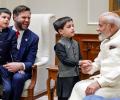
US Vice President JD Vance and Prime Minister Narendra Modi held a phone call to discuss expanding the India-US comprehensive global strategic partnership, focusing on trade, defence, energy security, emerging technologies, and critical minerals. The discussion comes amidst rising tensions in West Asia and recent regional realignments, with both leaders reaffirming their commitment to strengthening cooperation.

A readout by the US said the agreement marked a milestone in the strategic partnership between the two nations to ensure that the foundational elements required for advanced technology and energy are available within trusted networks.

The political confidence required to place high-end Japanese aircraft and personnel on Indian soil is itself a data point.
It indicates a level of trust that would have been difficult to imagine when India-Japan defence ties were largely symbolic, explains Varun Arya.

Prime Minister Narendra Modi and US Secretary of State Marco Rubio discussed various aspects of India-US bilateral ties, focusing on defence, trade, energy, and technology. Rubio extended an invitation from President Donald Trump for PM Modi to visit the US.

We are back to the 1971 moment with both China and the US supporting Pakistan, asserts Colonel Anil A Athale (retd).

New Delhi must look for formal, institutional statements issued directly from Washington rather than rely on casual pronouncements meant for local audiences, notes Ambassador Rajasekhar.

US Vice-President J D Vance's unexpected phone call to Prime Minister Narendra Modi on August 8 has ignited speculation about a potential diplomatic overture, possibly seeking India's support amidst the escalating US-Iran conflict and a shifting global power landscape, suggests Ambassador M K Bhadrakumar.

US Secretary of State Marco Rubio arrived in Kolkata for a four-day diplomatic tour to India, marking the first visit by a US secretary of state to the city in 14 years. His itinerary includes meetings with Indian officials, energy talks, and a Quad Foreign Ministers Meeting.
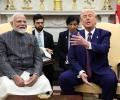
Prime Minister Narendra Modi and US President Donald Trump discussed the West Asia crisis and the importance of keeping the Strait of Hormuz open and secure. They also reviewed progress in bilateral ties and anticipated upcoming deals in the energy sector.

The Indian government informed Parliament that India and the US are engaged in negotiations for a mutually beneficial multi-sectoral bilateral trade agreement. The two countries also cooperate on strategic, economic, and defense matters, managing divergences through high-level dialogues.

US President Donald Trump lauded Prime Minister Narendra Modi's 'calm, cool, killer' persona at the G7 leaders' lunch in France, underscoring the deeply strategic relationship and formidable diplomatic skills of the Indian leader ahead of their crucial bilateral meeting.

AAP national convener Arvind Kejriwal has criticised Prime Minister Narendra Modi for thanking US President Donald Trump, arguing that India's sovereignty and national interest should be paramount. Kejriwal questioned the basis of Modi's gratitude, citing incidents involving attacks on ships carrying Indians and the deaths of Indian nationals, and called for strong leadership to protect India's interests.

India would confront a more entrenched China, a less dependable United States, and a regional order increasingly shaped by great-power bargaining over which it exercises limited influence, notes Amberish K Diwanji.
India and the United States have reviewed progress on a proposed interim bilateral trade agreement, discussing market access, digital trade, and non-tariff barriers, as they race to finalise a deal before a temporary 10 per cent US tariff regime expires on July 24.
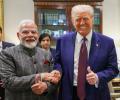
'I look forward to speaking with my very good friend, Prime Minister Modi, in the upcoming weeks.'

US Secretary of State Marco Rubio will visit India for four days to strengthen bilateral relations, holding talks with Indian leaders and attending the Quad foreign ministers' meeting.

'The flip side of this is that he won't hesitate to call out India if he thinks its policies are hurting US economic interests or border US foreign policy goals.'

The US embassy spokesperson issued a statement clarifying President Trump's views on India after a controversial social media repost. The statement emphasised the strong relationship between the two countries and Trump's positive view of India's leadership.

A senior US official has emphasised India's crucial role in maintaining peace and stability in the Indo-Pacific region and ensuring a balanced power dynamic in Asia, advocating for stronger defence ties between the two nations.

India has joined the US-led 'Pax Silica' alliance, aimed at building a resilient supply chain for critical minerals and artificial intelligence, marking a significant step in strengthening bilateral ties and fostering economic security.
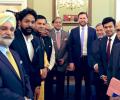
In a post on X, the Indian Embassy in the US said that the all-party parliamentary delegation led by Tharoor called on Vice President Vance this morning.

The deal shifts the US posture towards India from hostile to neutral, and that matters for growth, points out T T Ram Mohan.

The India-US trade deal has offered a much-needed breather for the Indian information technology (IT) industry, which has been grappling with global macroeconomic uncertainty and subdued client spending over the past few years.
Prime Minister Narendra Modi and US President Donald Trump discussed enhancing economic ties and a potential trade deal during a phone conversation.

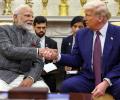
A US lawmaker and former officials warn that President Trump's policies are damaging the strategic partnership between the United States and India, potentially driving India closer to China and Russia.

India and the US have signed a framework agreement for defence cooperation for the next 10 years, enhancing their partnership and aiming for regional stability.

'The US values its relationship with India and under the strong leadership of President Donald J Trump and Prime Minister Modi, I am optimistic about the days ahead for both of our nations.'
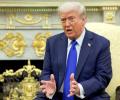
The US Representative criticised the administration's new USD 100,000 fee on H-1B visas, observing that Indians hold 70 per cent of these visas and saying the change directly harms workers who have long supported US innovation across technology, science and medicine.

The scaling up of the India-US strategic partnership to the level of non-NATO ally with defence deals, sharing and transfer of defence technology, interoperability, joint collaboration and joint production of defence equipment has exacerbated Moscow's anxiety, notes Rup Narayan Das.
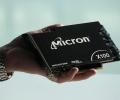
Prime Minister Narendra Modi inaugurated Micron Technology's semiconductor plant in Sanand, Gujarat, highlighting India's growing presence in the hardware sector and its strong partnership with the United States in AI and chip technologies.

US President Donald Trump greeted India on its 77th Republic Day, highlighting the historic bond between the two democracies amid ongoing trade tensions.

Gor, 38, was among 107 nominees confirmed by the Senate in a single en bloc vote on Tuesday, with 51 senators voting in favour and 47 against.
Trump announced that India and the US agreed to a trade deal under which Washington will charge a reduced reciprocal tariff on Delhi, lowering it from 25 per cent to 18 per cent.

Prime Minister Narendra Modi on Saturday met United States Ambassador-designate to India Sergio Gor and said he was confident that India-US ties will further strengthen during his tenure.
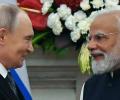
United States representative Sydney Kamlager-Dove while talking about the famous car selfie of Prime Minister Narendra Modi with Russian President Vladimir Putin said that it spoke a thousand words.

The India-US strategic partnership is characterised by mutual trust and both sides are increasingly in agreement on key issues, such as countering China's aggression, promoting a free and open Indo-Pacific and addressing regional security challenges, Defence Minister Rajnath Singh said on Friday.
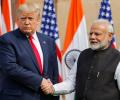
The China threat continues to resonate in the strategic partnership between India and the USA, points out Rup Narayan Das.
